A fundamental premise in sports or behavioral training lies in the acquisition of habits. Whenever we train something, our body acquires “knowledge” (body knowledge or bodily knowledge), thereby acquiring a specific habit.
Habits such as walking and running, grabbing, throwing, kicking, playing instruments, using rackets, canes, etc.
In acquiring these habits, we acquire abilities (skills, competencies), whatever they may be.
And here lies the first major challenge for coaches!
As far as possible, it is important that the coach does not allow the acquisition of “bad habits.”
In other words, it is essential that the coach knows that we automate and make both good and bad habits unconscious.
This makes it extremely demanding for the coach to frame their work! They must avoid at all costs that the “knowledge of the body,” the continued incorporation of those they train, is not that of bad habits, but rather that of good habits, those that they ultimately want them to acquire.
For example, if we wait for latecomers at the beginning of a session, we “punish” those who arrived on time!
So, we “accustom” those who train to “arrive late”!
Look at another example!
If I get used to facing all kinds of adversity and obstacles, I automatically react positively whenever I encounter any kind of difficulty! But the opposite is also true!
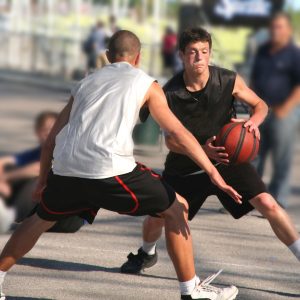
Remember my personal story as a young basketball player and the hook shot I specialized in.
I was only able to shoot hook shots if I didn’t face any obstacles other than myself, the ball, and the basket! When faced with any obstacles, such as opposition from opponents or movements from my teammates, I would “block”!
What a serious mistake in teaching and learning! He had learned and trained to perform the hook shot without any opposition! Therefore, it was out of context and circumstances of the real game situation where “opposition is a factor of progress”!
Today, there is scientific, neuroscientific, and philosophical consensus on the importance of the concept of embodiment, understood as the gradual and continuous modulation of our neural structure. We learn any skill or ability by embodying
everything we experience from a motor and sensory point of view. In this way, we shape our neural structure in an integrated and complementary manner.
It should also be added that our perception of everything around us is intermodal, thus complementing everything that is physical, mental, emotional, social, and spiritual. The experiences we have are also global and extremely complex.
More specifically, our body, through its motor skills and abilities, when moving or adopting certain postures, not only informs but also modulates our cognition. In essence, the body modulates the mind.
As Shaun Gallagher’s book “How the body shapes the mind” so clearly explains. A must-read!
In other words, our body movements and motor system profoundly influence cognitive performance.
Once you get here, it’s easy to understand what my coaches meant when they said, “play like you train.”
Of course!
If you “play badly,” it’s because you “trained badly”!
The opposite is equally true!
“You play as you train, which means training as you play”!
This is a fundamental issue, because if the game is diverse, complex, emotionally engaging, socially demanding, always challenging from a spiritual point of view, requiring constant physical and mental improvement, then training must also contain all these demands and stimuli!
And coaches, whether sports or behavioral, who are more concerned with the development of those they train than with the convenience of “giving training sessions” that have been planned in advance, must be able to face training situations on a daily basis that are as demanding and diverse as “game situations,” if not more so.
An example? Recently, during a behavioral training session I attended on a Friday afternoon, the context of that group of participants “required” the trainer to be able to deal with a group of participants who were mostly dropouts, or rather, who were eager to get to the weekend… But what had to happen happened!
Thanks to the total dedication of the coach leading the session and his flexibility and adaptation to an extremely negative situation, I attended a behavioral training session where it was possible to say the following in the final feedback:
- impressive how, despite so many signs of giving up and disinterest, it was possible to achieve this positive result and this involvement and emotional commitment to common goals!
- It is important to highlight how decisive the presence of an exemplary team captain was, capable of mobilizing a group that initially seemed demoralized, to achieve such an exciting finish!
Some may ask, but what was the “secret” after all?
Everything was based, on the one hand, on the coach’s ability to “give the team and each of the participants what they needed at any given moment” and, on the other hand, on the existence of a team captain who knew how to set an example of enthusiasm and engaging dedication to everyone’s commitment to common goals.
Conclusion?
Attitude makes all the difference!
Especially when this attitude is not only that of the coach, but also that of some members of the team.